Saturday, August 30, 2014

Louisiades Prep - The Boat, Health & Safety

A lot of work has gone into our proposed trip to the Louisiades. I thought I would write it down, not because I imagine it will greatly interest the casual reader of this blog, but in case someone else is planning a similar trip and might find it helpful.

I'll organize it into three sections: boat, health and safety.
  • Electronics. This was triggered by the lightning strike we suffered in March 2013. Pretty much the whole electrical side of the boat had to be renewed. I have tried to increase our inputs, decrease our outputs, and improve the storage with lithium batteries. We have ended up with 280 usable amp-hours, whereas we previously had 120.
  • Watermaker. We have a Spectra Ventura 200T watermaker with extra gadgets. It worked well, and reduced a whole lot of worries about access to clean water in the islands, some of which had been having a drought.
  • Solar inputs. An additional two 120 watt solar panels have been added zipped into the canvas sunshades. That gives us 490 watts. There is a new MPPT solar regulator which is a lot more efficient than the previous one, and allows us to charge at up to 36 amps at mid-day in full sun.
  • LED TV. The original fitted TV was quite greedy of amps. The new one is an LED Kogan 12 volt one. My impression is that it saves us about 30 amp-hours on a night when we are watching TV or a video.
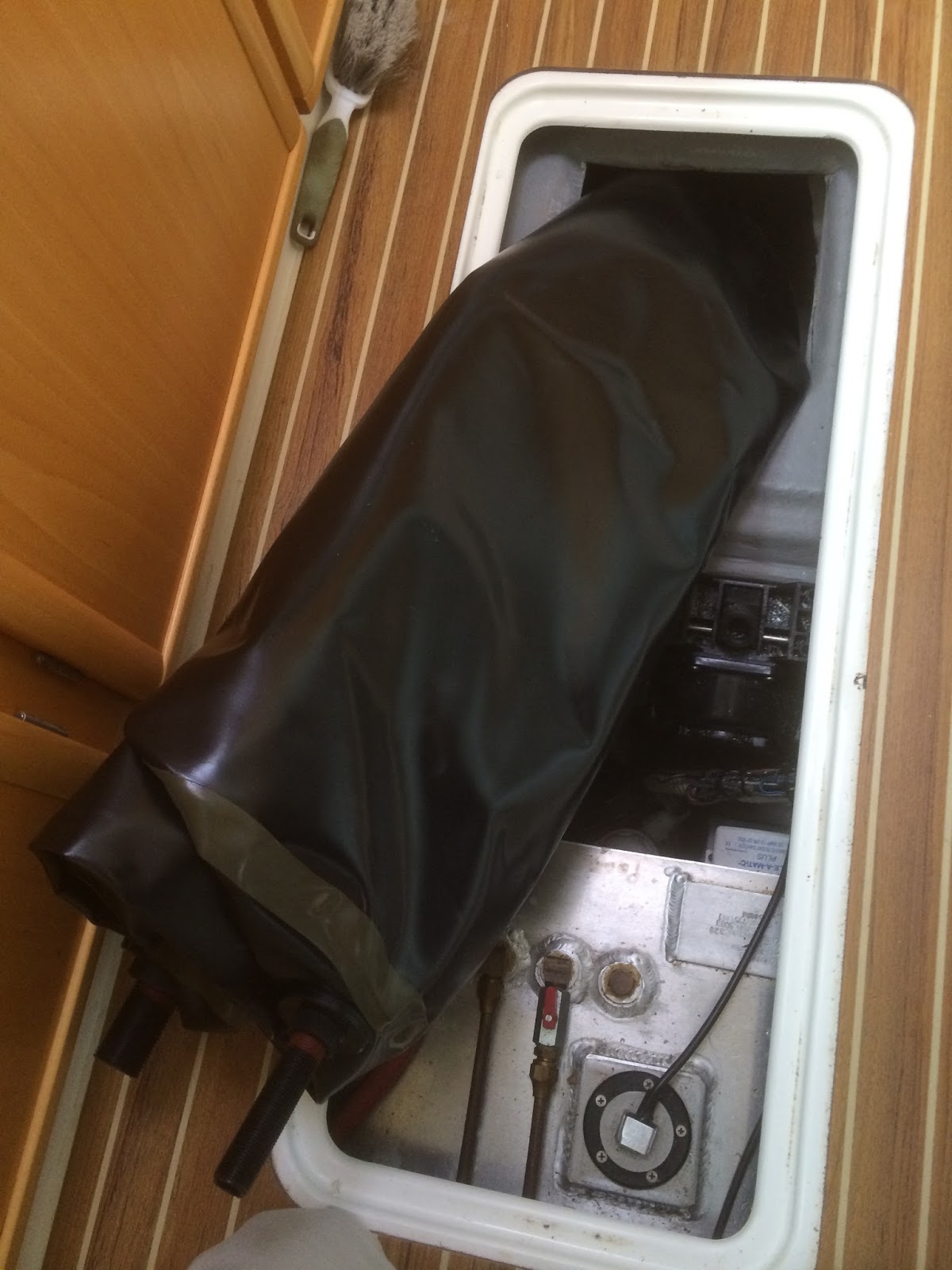
  • Extra diesel. A bladder in the bilge of the port hull carries 100 litres. Two jerry cans in the genset locker. So 320 litres in normal tanks, 140 litres extra. Total 460 litres. We also have a Mr Funnel fuel filter which we used in Misima.
  • IsatPhone Pro satphone. The economical mode is SMS, but we can talk direct, and also use it as a modem to pick up GRIB file weather forecasts. With a Mac we use UUPlus for email, and zyGrib as a GRIB viewer. 
  • Insurance. We had been insured by Nautilus until recently. They managed our claim after the lightning strike pretty well. But when we applied for a quote if we went to PNG the consequences were expensive, and included a $20,000 excess. We got an alternative quote from Topsail, and it came in at half the price, with no excess.
  • Travel insurance. We are both in Avant, a medical malpractice insurance scheme. We discovered that an add-on to the normal policy gives us year-round travel insurance very economically.
  • Tradeables. The Louisiades are very poor, and few people use cash. To get veggies, crayfish and other things like carvings, you need to carry stuff to trade. Here are some suggestions of things that go down well.
    • Fresh fish caught while sailing to the anchorage
    • Baby and kids clothes
    • Soap
    • Small shorts for boys and blokes...they are all slim! 
    • Shirts and ladies tops
    • Hats and caps
    • Thongs, crocs, joggers
    • Sports gear esp soccer spikes, sox, shorts etc
    • Sports bags, backpacks, Hong Kong bags
    • Reading and sunglasses
    • Baby bottles , powdered milk
    • Food : rice, flour, sugar, onions,oil, tea, coffee, biscuits, tinned meat and fish
    • Fishing gear: big hooks, line 150lb and much lighter 40 kg, sinkers
    • Carving tools , pliers, saws, hand drills and drill bits
    • Rope, sail fabric, tarps, sail cloth needles
    • Sewing fabric, scissors, needles, cotton, elastic, Singer sewing machine needles
    • Solar rechargeable lighting and torches
    • Small frypans and saucepans, all kitchenware and utensils
    • Batteries
    • Exercise books, biros, rubbers, pencils, rulers, 
  • Health. There are some serious bugs afoot in the tropics, especially ones carried by mozzies, like dengue fever, malaria, and Japanese encephalitis. So we have taken care to get serious mozzie screens over all the windows and doors, including the big trifold doors and the opening windows at the front of the main cabin. Beyond that, we trust the Travel Doctor who specializes in the sort of information one needs for this sort of project. In effect this has included:
    • Japanese encephalitis
    • Prevenar 13 (pneumococcus)
    • Adacel (diptheria, tetanus, pertussis)
    • Dukoral (cholera) 2 drinks
    • Vivotif (typhoid) 3 capsules on alternate days
    • Anti-malarial Malarone (start 2 days before entering malaria zone)
    • Hand sanitizer
    • Bushmans repellent
    • 'Travelling Well', by Deborah Mills. A 'must-have' book.
    • A comprehensive First-Aid kit.

  • Safety experts say you can't use a RIB as a life-raft. I think that one of the plausible disasters to prepare against is getting wrecked on a coral reef. If that were to happen on the windward side, it would worry me to launch a self-inflating kids paddling pool (aka 'Life-raft') which would blow downwind across the coral. Much better to get in the RIB, motor to a safe place, and then hang to a drogue while satphoning for help. To protect against the elements, we have fitted little tubes to the side of the RIB, into which fit tent hoops supporting a heavy duty PVC shelter. We also have a conventional life-raft, the yellow package under the BBQ.


Abandonment gear: full wet weather suit, soft shoes, lifejackets with crotch strap, water activated torch, gloves.


Flares, water, food, V sheet, mirror, torches, sunscreen, reflector, Sat phone, personal EPIRB, hand held VHFs, knife, sunglasses, reading glasses, can opener, first aid kit, seasickness tabs, vomit bag, paper and pencil, batteries, towel, Vaseline, horn, fluoro light sticks, mobile phones. 


Passports, credit cards, boat documents: insurance and rego, emergency books,  drill sheets,  list of last minute things to add.


We found the best anti-nausea pill is Cinnarizine (Stugeron).

Tuesday, August 5, 2014

Maggie Island

Townsville is particularly blessed as a port because it has an off-lying island as an easy destination for a sail. Magnetic Island is affectionately known by locals as Maggie Island. It is lovely. Beautiful walks, stunning bays. Picturesque granite boulders everywhere, and a bit of military history.

 View from The Forts, a WWII gun-post.

 Koala

 Arthur bay

Friday, August 1, 2014

Easy cruising

This cruise is particularly undemanding. Lovely sunny weather, a gentle SE trade wind of 10-20 knots most of the time, and not far to go from Airlie Beach to Townsville in two weeks.

So we have been enjoying the easy pace, some lovely sails, and sorting out a few tasks before the big trip in September.

Here I am trying out a new cover for the RIB in case we have a 'Life of Pi' experience. We also have an official life-raft, but I regard it as little more inviting than a blow-up kids paddling pool. We may end up with two separate ones; one for us and one for the tiger!


More safety rehearsals

A few days in the Whitsundays.

Stonehaven Bay sunset 

We are not Tamils, honestly hossifer!

 Bowen headland

Some success. A spotted mackerel

A fisherman at Bowen who is more successful than us!

 Coal ships at Abbott Point

Trawlers at Cape Upstart


There is a controversy currently raging about the dredging of the area around Abbott Point as part of a plan to increase coal exports from Queensland to India. Read about it here. The concern, which is entirely legitimate, is that the spoil from the dredging will damage the Great Barrier Reef, which is already under stress from various environmental threats.

The GBR is on a shallow shelf about 50-60 metres deep. I am surprised that neither the proponents nor the opponents of the scheme have put up the idea of dumping the spoil off the edge of the continental shelf, less than 80 nautical miles away. It would do much less damage there.


There is currently a plan to prohibit spoil dumping at sea entirely, and to drop in on land. The case against this is discussed here.

Tuesday, July 29, 2014

Solar developments

We are back aboard in the Whitsundays, with the simple project of enjoying a relaxing cruise to Townsville, and ensuring that all is in order for the big adventure to the Louisiades starting on September 12th.


I thought I would discuss developments in solar power on boats, for those interested. No doubt some readers of this blog are already ahead of me.

After the lightning strike, and the electrical refit that followed, I asked for consideration to be made for a future increase in solar panels. As part of that, our solar regulator was changed from a Steca Solarix PRS 2020, which used the PWM system and was good for 20 amps, to a Morningstar Tristar TS-MPPT-60 solar controller, which uses the MPPT system, and can handle 60 amps.

The difference between PWM and MPPT is important.

In simple terms, the task of the controller is to reduce the voltage coming from the panel to a level that is safe for the battery. This is particularly important with the lithium batteries that we have. The older systems of solar regulator basically throw away any voltage that is too high.
But the MPPT (Maximum Power Point Tracking) solar regulators manage to convert excessive volts into more amps at 12 volts (safe for the batteries), thus increasing the effective yield from the panels.

Another bonus from this is that one can attach more than one panel in series, and boost the harvest from the beginning and end of the day when the sun is weaker. The Tristar TS-MPPT-60 can accept up to 150 volts maximum. 

The second development of interest is the arrival of Solbian thin flexi-panels that can be zipped into canvas shades. Previously I had imagined that we would need to build some solid fibreglass panels and mount conventional solid glass panels on them. Because they will lie under the boom, and dangling ropes such as reefing lines sometimes sweep across the cockpit roof at speed when we gybe, I had imagined our expensive solar contraptions landing with a splash somewhere downwind.

But the recent arrival of 2mm thick flexi-panels means that we can zip them into our existing canvas sunshades with minimal weight and expense. 


They are connected as two sub-arrays, port and starboard, with the pair on each side connected in series, and the two subarrays connected in parallel to the MPPT controller.

Each sub-array can put out a maximum of 48.5 volts. The MPPT controller massages that down to a safe level and boosts the amps.

On a sunny day I have seen it registering 25 amps. Loverly! My Dad would have been very impressed!

I can unzip the panels and remove them and roll away the sunshades if we are leaving the boat over the cyclone season, or are exposed to high winds.

All good!

Wednesday, June 18, 2014

Seawind regatta

We joined a week-long regatta for Seawind catamarans around the Whitsundays. Various bits of fun and games. Some racing.

 Off the beach at Long Island

 Graeme Nolan, organizer of the rally

Hawaiian night

 Racing from Long Island to Nara Inlet

 Duet, a Seawind 1200

Reflection, a Seawind 1250

 Backpacker sunrise

Friday, June 13, 2014

Climbing Whitsunday Peak

 Skink and fungi


 Daniel Point and Hook Passage

 Gulnare Inlet and Hamilton Island


Thursday, June 12, 2014

Wetsundays

After spending the cyclone season in Mackay, we are back on board at last. We sailed Nimrod first to Shaw Island, and then to collect our friends Tiff and Dawne from the airport at Hamilton Island.

Dawne & Tiff

The weather has been pretty grim; gusty and heavy rain at times. We hid in Cid Harbour with many other boats, and had a splash out to the iconic Tongue Bay and Hill Inlet, before a brief snorkel in Cateran Bay on Border Island. We then retreated to the shelter of the deep fjord-like inlets of Nara and Gulnare.

Cid Harbour


Hill Inlet 

Nara Inlet 

Rain

Gulnare Inlet

Followers